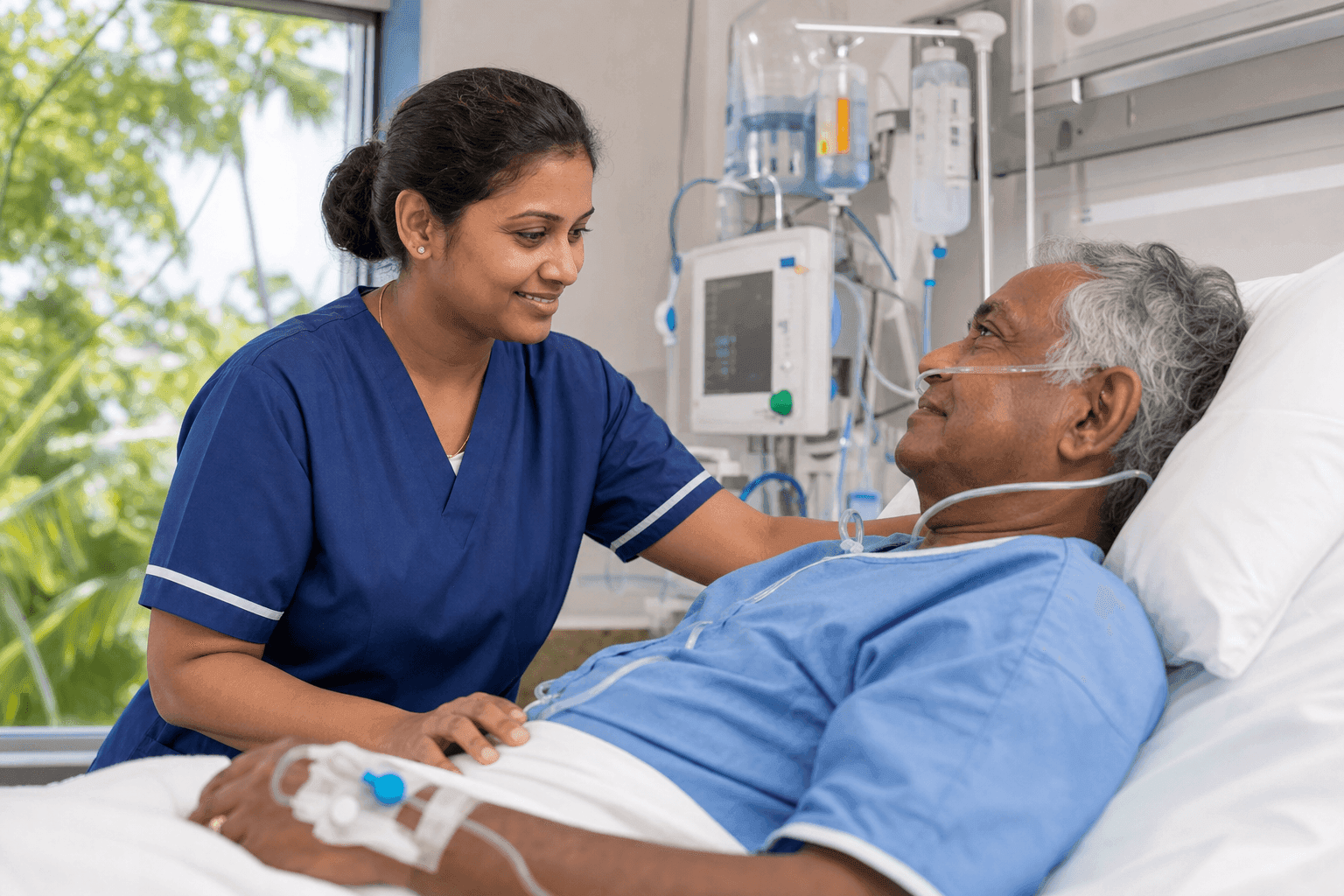
In every hospital there is a place where medicine works at its most intense: the intensive care unit. Here, the most seriously ill and injured patients are cared for, often between life and death. At the centre of this environment stands the critical care nurse, one of the most highly skilled members of any health team. Their role is demanding, technical, and profoundly human.
Care at the sharpest edge
Patients in an intensive care unit, or ICU, are there because one or more of their vital body systems is failing or at risk. They may be recovering from major surgery, fighting severe infection, or stabilising after a serious accident or a heart or breathing emergency. Many are unconscious, sedated, or dependent on machines to breathe.
A critical care nurse usually cares for only one or two patients at a time, compared with the larger groups managed on a general ward. That close ratio exists for a reason: these patients need constant, minute-by-minute attention, and their condition can change in seconds.
The skill of intensive monitoring
The defining skill of critical care nursing is continuous, expert observation. The nurse watches a stream of information from monitors tracking heart rhythm, blood pressure, oxygen levels, breathing, and more. But the machines are only tools. The real skill lies in interpreting all of that data together, alongside what the nurse sees, hears, and feels at the bedside.
A small shift in a number, a change in skin colour, a different pattern of breathing, these can be the first sign of a serious problem. The critical care nurse must notice it, understand what it means, and act, often before a doctor is even at the bedside. This blend of technical knowledge and sharp clinical instinct takes years to develop.
Managing complex technology
Critical care nurses work with some of the most advanced equipment in the hospital. They manage ventilators that breathe for patients, infusion pumps delivering precise doses of powerful drugs, and monitoring lines that track pressures deep inside the body. They must understand not only how to operate this technology but how to recognise when it is failing or when the patient is fighting against it.
Alongside the machines, these nurses handle detailed medication regimes, where a small error could be dangerous. Precision, double checking, and calm focus are part of every shift.
Thinking fast, staying calm
Emergencies are part of the job. When a patient suddenly deteriorates, the critical care nurse is often the first responder, beginning resuscitation, calling the team, and coordinating the response. The ability to stay calm and think clearly under extreme pressure is what sets these nurses apart.
This calm is not the absence of stress. It is trained composure, built through experience, preparation, and teamwork. The best critical care units function as tight teams where nurses and doctors trust each other completely, because lives depend on that trust.
Caring for families too
For families, having a loved one in intensive care is one of the most frightening experiences imaginable. The critical care nurse is often their main source of information and comfort. They explain what the machines are doing, what the plan is, and what to expect, translating a bewildering, high-technology environment into words a frightened family can hold onto.
This emotional support is not a side task. It is central to good critical care. When treatment cannot save a patient, these nurses also guide families through the hardest moments with honesty and compassion, ensuring dignity to the very end.
Building critical care nursing in Mauritius
As Mauritius develops its healthcare system, strong critical care capacity becomes ever more important, whether for road accident victims, patients with severe infections, or those needing complex surgery. Building this capacity means investing in specialist nurse training, because a well equipped ICU is only as good as the nurses who staff it.
For nurses seeking a challenging and deeply respected specialisation, critical care offers exactly that. It asks for advanced skill, emotional strength, and total commitment. In return, it places you where your knowledge and presence make the clearest possible difference: at the bedside of a patient whose life hangs in the balance.
Nurses are the heart of healthcare in Mauritius. Explore the wider Medtech health ecosystem.